CheckMate evaluates handwritten answer sheets in minutes — partial credit, per-student feedback, and a full audit trail. Built for Indian schools. Powered by Google Cloud and Gemini.
Teachers in Indian schools spend 10–15 hours every week evaluating written exam papers. Time stolen from teaching, lesson prep, and family. Then, there are mistakes by teachers, sometimes there is emotional or instinctive marking which may be benificial for one student and unfair for the other. This tool can impact nearly a Billion people in India if we consider fairness in evaluation it brings. Students are judged based on the exam results which are many times evaluated with tired minds.
Three steps. Built for the realities of Indian classrooms: phone-photo answer sheets, mixed handwriting, varied curriculum, and per-school rubrics.
Teacher uploads the question paper once. AI extracts every question, marks-allocation, and rubric automatically.
Scan answer sheets preferably from high speed scanners (or even a phone). We handle multi-page submissions, rotation, and OCR.
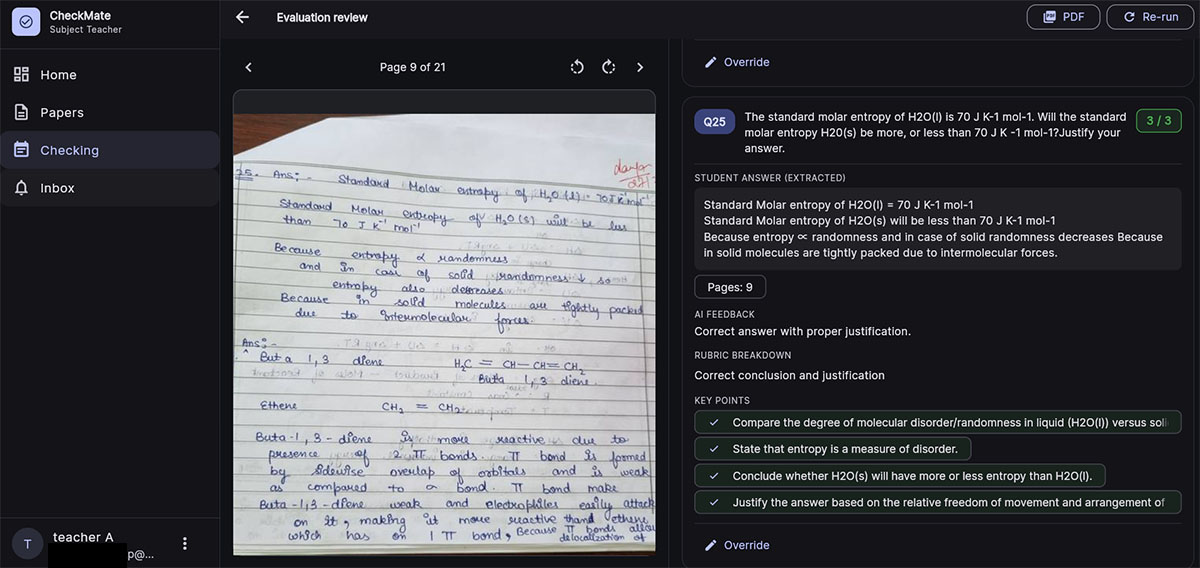
AI awards marks per question with partial credit and feedback. Teacher reviews, overrides where needed, exports a PDF report.
Most "AI grading" tools call an LLM and return whatever it says. CheckMate is built differently: the LLM perceives, deterministic code structures, and the teacher confirms. Every correction a teacher makes becomes labeled training data — and quarterly, we plan to fine-tune a CheckMate-specific model on that corpus.
The corpus will be the moat. Months of teacher-validated extractions and gradings from CBSE, ICSE, and state-board papers is something no competitor can buy off the shelf. It compounds with every evaluation.
Gemini 3.5 Flash reads the paper image once and returns a flat list of what it sees. No reasoning about structure, no guessing about marks distribution — pure perception.
Deterministic post-processing assigns alternative-block IDs (for "either/or" questions), hoists shared passages, detects undistributed marks, and flags ambiguity. Predictable. Auditable. Cheap.
Quality issues surface as suggestions, not silent edits. Teacher accepts, overrides, or dismisses with a reason. Every action is captured — and becomes training data for the next model.
Every major entrance exam in India is multiple-choice. JEE, NEET, CAT, UPSC Prelims, banking exams, state PSCs — together evaluating roughly 80 million students every year. They are MCQ not because MCQs measure ability well — they measure recognition, elimination, and luck. They became standard because written-answer evaluation does not scale. Nobody can hand-grade 13 lakh JEE papers fairly.
The constraint that built MCQ-dominance was evaluation cost. If trustworthy AI evaluation removes that constraint — for written long-form answers, at exam-volume scale, with auditable per-answer reasoning — the entire system can move back to the format that actually tests how a student thinks.
An evaluation tool only works if teachers trust the result. AI CheckMate is built around that.
Every mark comes with reasoning the teacher can verify in seconds — not a black-box score.
The teacher is always in control. AI proposes; teacher decides. Every override is logged in the audit trail.
Per-institute data isolation, secured by Google Cloud + Firebase. School data never leaks across tenants.

I'm a software engineer who's been shipping products end-to-end for the last decade — first at Nokia, Samsung, and Infosys, and now full-time across Qwizee (a job-prep app) and CheckMate. CheckMate is my bet on what AI can finally do for India's 10M+ teachers: take the grading burden off their plate without sacrificing the trust that comes from a real teacher's verdict.
Are you a school admin, teacher, EdTech founder, or investor exploring this space? Drop a note — we read every message.
Or email us directly: founder@aicheckmate.in
 AI CheckMate